
Planning a house move? Packing is one of the biggest tasks, and it all starts with one key question:
How many moving boxes will you actually need?
At ASP Transport & Removals & Storage, we know that guessing can lead to stress, delays, and unnecessary costs. That’s why we’ve created this detailed guide to help you calculate the right number of boxes based on your home, lifestyle, and belongings.
Let’s break it down step by step to make your packing process smoother, faster, and more cost-effective.
Why Estimating Box Numbers Matters
Running out of boxes halfway through packing is frustrating. Buying too many wastes money and space. A good estimate:
-
Keeps your packing organised
-
Prevents overbuying supplies
-
Ensures your items are protected
-
Helps with van space and loading order
Whether you live in a studio flat or a 4-bedroom house, understanding your box needs makes your move more efficient and less stressful.
Step 1: Use Your Home Size as a Starting Point
A quick way to begin is by using your property’s size. Here’s a general guide:
-
Studio flat – 10 to 20 boxes
-
1-bedroom home – 20 to 40 boxes
-
2-bedroom home – 40 to 60 boxes
-
3-bedroom home – 60 to 80 boxes
-
4+ bedroom home – 80 to 120+ boxes
This gives you a ballpark figure. But to fine-tune your estimate, you’ll want to consider what you actually own.
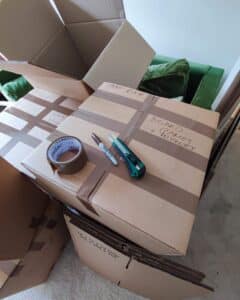
Step 2: Walk Through Your Home and Take Inventory
Spend time going through each room, noting what needs to be packed. Divide your belongings by category to choose the right type of box.
-
Heavy items (books, tools, kitchen gadgets)
Use small boxes so they’re not too heavy to carry. -
Light but bulky items (clothes, bedding, toys)
Use medium or large boxes to save space. -
Fragile items (glassware, electronics)
Use double-walled boxes or specialist packaging for added protection.
Create a checklist for each room — kitchen, bedrooms, lounge, bathrooms, garage, and attic. Knowing what’s going in each box helps you plan better and label clearly.
Step 3: Use Our Free Moving Box Calculator
Not sure how to turn your inventory into a box count? Let us help!
At ASP Transport & Removals & Storage, we offer a free moving box calculator. Simply enter:
-
Number of bedrooms
-
Number of people living in the house
-
How many rooms need packing
-
Types of items you own
You’ll get a tailored estimate in minutes. Contact us today to access the calculator and plan like a pro.
Step 4: Factor in Your Lifestyle
Two families with the same house size can have completely different packing needs. Your lifestyle plays a big role:
-
Minimalists may need fewer boxes since they own fewer things.
-
Collectors or families with children often need more — think toys, décor, or hobby gear.
-
Home workers must account for extra tech, paperwork, and supplies.
Be realistic about what you own. It’s better to plan for more than to find yourself short on moving day.
Step 5: Always Overestimate (Just a Bit!)
Even with careful planning, surprises happen. Maybe you forgot about the loft. Maybe you find more bits tucked away in drawers. That’s why we always recommend adding 10% to 20% extra boxes to your estimate.
You can always return unused boxes (if allowed), or keep them for storage. It’s better than scrambling for extras at the last minute.
How to Choose the Right Box Sizes
Not all boxes are equal. Choosing the correct size keeps your belongings protected and your boxes easy to lift.
Small Boxes (1.5–2 cu. ft.)
Ideal for heavy items such as:
-
Books
-
Tools
-
Tinned goods
-
Small electronics
Use small boxes to keep the weight manageable.
Medium Boxes (3–4 cu. ft.)
The most versatile size. Great for:
-
Clothes
-
Toys
-
Kitchenware
-
Office supplies
Use these in most rooms — especially bedrooms and kitchens.
Large Boxes (4.5–6 cu. ft.)
Perfect for lightweight, bulky items like:
-
Bedding
-
Cushions
-
Lampshades
-
Towels
Avoid putting heavy items in these. They’ll be harder to move and may break.
Specialist Boxes
Some items need extra protection:
-
Wardrobe Boxes: Move clothes on hangers with no creasing
-
Dish Packs: For crockery and glasses
-
Mirror/TV Boxes: Protect fragile frames and screens
-
File Boxes: Great for office moves or paperwork
Pro Tip: We stock eco-friendly moving boxes for purchase or rental — durable, reusable, and perfect for a greener move.
Smart Packing Tips to Make Moving Easier
Label Clearly
Write the contents and the destination room on every box. Use a bold marker and keep it visible on multiple sides.
Example: Kitchen – Plates & Bowls
Pack Heavy Items First
Put heavier items at the bottom of each box, then add lighter ones on top. This prevents damage and makes stacking safer.
Use Quality Packing Materials
Don’t skimp on the essentials. You’ll need:
-
Strong packing tape
-
Bubble wrap or packing paper
-
Stretch wrap for furniture
-
Labels or stickers
If you need materials, we’ve got everything in stock — just ask!
Declutter Before You Pack
Before putting things in boxes, ask yourself:
Do I still need this?
Sell, donate, or recycle items you no longer use. Less stuff means fewer boxes, lower costs, and a fresh start in your new home.

Why Choose ASP Transport & Removals & Storage?
We’re not just here to move your stuff — we’re here to make your move smarter, safer, and smoother.
Here’s what you get when you choose ASP Transport & Removals & Storage:
✅ Eco-Friendly Moving Boxes
Buy or rent strong, sustainable boxes in every size.
✅ Expert Packing Services
Our trained team knows how to pack quickly and securely. Let us handle it for you.
✅ Secure Storage Options
Need to store items before or after your move? We offer climate-controlled, secure storage for short or long stays.
We’ve helped hundreds of customers across [Your City/Region] move stress-free — and we’re ready to help you too.
Let’s Make Packing Easy
Don’t let packing slow you down. With the right number of boxes, smart planning, and support from our expert team, you can move with confidence.
📦 Get your personalised moving box estimate today
📦 Buy or rent premium boxes from us
📦 Book our packing service for total peace of mind
Contact ASP Transport & Removals & Storage now for a free quote or to access our moving box calculator.
Let’s get your move on the road!
Frequently Asked Questions: How do I figure out how many moving boxes I need?
Q: How many boxes do I need for a 2-bedroom house?
A: Most people need 40–60 boxes, depending on how much you own. Use our box calculator for a personalised estimate.
Q: Can I reuse boxes from a previous move?
A: Yes — as long as they’re clean, dry, and sturdy. However, old boxes may be weakened or misshapen. For the best protection, we recommend using new, high-quality boxes from us.
Q: How should I pack fragile items?
A: Use dish packs, bubble wrap, and reinforced boxes. Don’t overpack, and clearly label the box as fragile. Or leave it to us — we offer expert packing services for delicate items.
Q: How do I know what size boxes to use?
A: Use small boxes for heavy things, medium boxes for general use, and large boxes for bulky but light items. Specialist boxes are ideal for clothing, dishes, or fragile items.
Q: What if I buy too many boxes?
A: We always recommend buying a few extra just in case. If you have unused boxes in perfect condition, we may accept returns — ask our team when you order.
Contact Us: How do I figure out how many moving boxes I need?
Office: 01604 437028
Peter: 07711 795 214
Jerry: 07748 144 354
Evelina: 07701 367 549
Mail us: info@asp-service.co.uk
Discover ASP Transport & Removals & Storage’s best services in different Locations